 Catamaran Cruises in Santorini
The Santorini Volcano: Nea Kameni, Palea Kameni and How to Visit
The Santorini volcano is not the cliff-rimmed island you sleep on. It is two dark lava islets, Nea Kameni and Palea Kameni, sitting in the flooded caldera at the center of the ring. This guide explains how they formed, when the volcano last erupted, whether it is still active, what the crater walk on Nea Kameni costs and involves, and how to reach the islets by boat. You will also see how a volcano landing tour differs from a Santorini catamaran cruise, whose listings describe no landing on the islets.
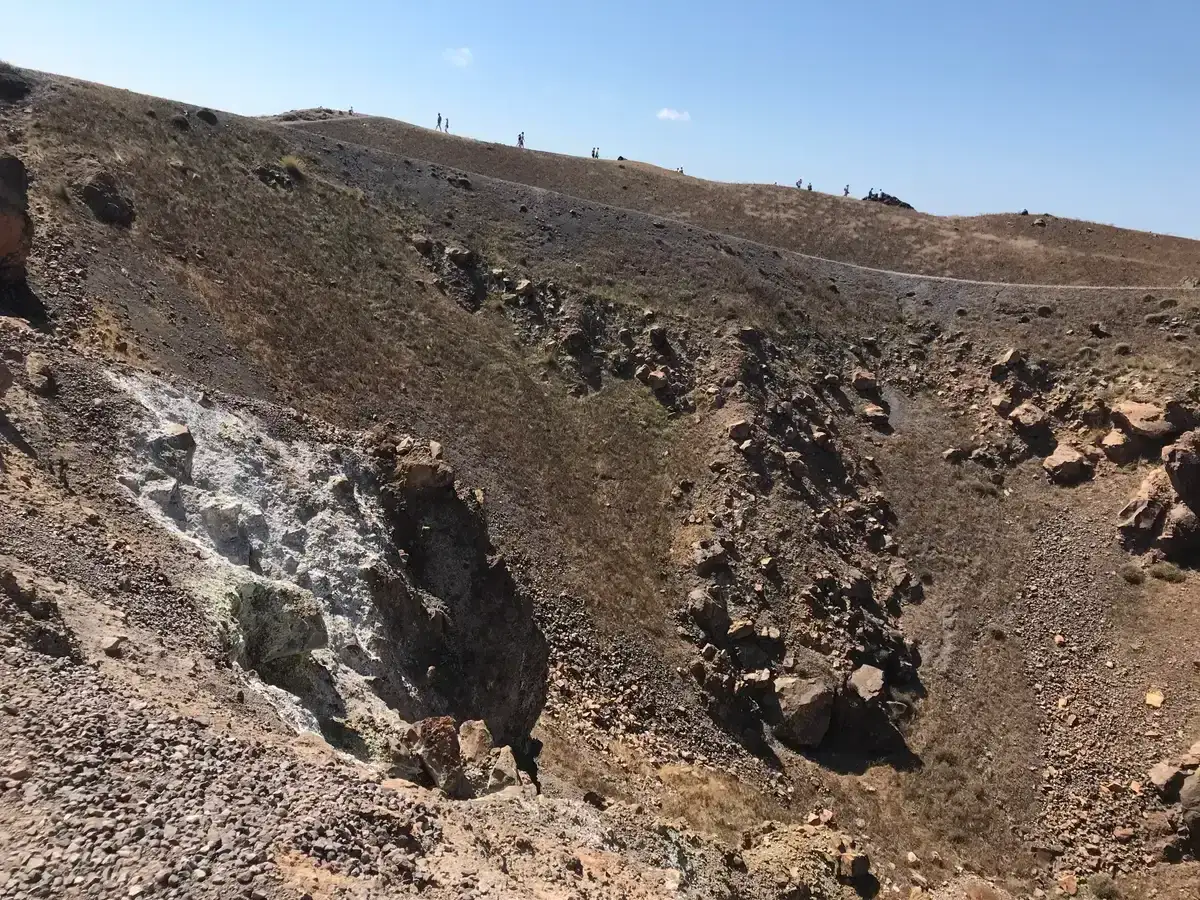
A crater on Nea Kameni, the volcanic island in the middle of the caldera. Photo: Zde, CC BY-SA 4.0, via Wikimedia Commons
Quick answer The Santorini volcano in brief
The Santorini volcano is the pair of lava islets Nea Kameni and Palea Kameni in the center of the caldera. Nea Kameni covers 3.4 square km and Palea Kameni 0.5 square km. The last eruption was in 1950. The volcano is classed as dormant, not extinct, and is monitored by ISMOSAV.
Key takeaways
- You can climb to the crater rim on Nea Kameni in a 20 to 30 minute walk on a gravel path, with a 5 euro cash fee paid at the site.
- To land on the volcano you need a dedicated boat tour, such as the volcano cruise with hike and hot springs swim, which leaves from the Old Port or Athinios.
- Catamaran listings describe no landing. The Renieris Classic Catamaran, for example, lists Nea Kameni among its stops.
- The water, cliffs and eruption history that shaped the whole island are covered in the guide to the Santorini caldera.
Nea Kameni and Palea Kameni
The Santorini volcano today means two islets of black dacite lava that grew out of the sea inside the caldera lagoon.
What and Where
Ask a geologist where the Santorini volcano is and the answer is not the cliff-top villages. The main island of Thera is the rim of a huge collapsed caldera that measures about 12 by 7 km and is up to 385 m deep. The active part is in the middle of that flooded basin: two young volcanic islets, Nea Kameni and Palea Kameni.
Nea Kameni, which means new burnt in Greek, is a nearly round lava dome about 2 km across, built of dacite lava and ash. It is the larger of the pair at 3.4 square km, and it rises from the water in ridges of black rock with no shade and no shops. Its neighbor Palea Kameni, old burnt, is much smaller at 0.5 square km. It formed far earlier, from eruptions between 197 BCE and 47 CE, and Wikipedia notes it was once a private island, bought in 1899 and sold in 1975. A herd of goats lives there, and Wikivoyage counts a church and a single resident.
The islets sit in the same water as Aspronisi, a tiny uninhabited island 650 m long and 200 m wide partly made of white pumice, and across the lagoon from Thirassia, the second-largest island in the group at 9.3 square km. The whole volcanic history of Santorini spans 3.5 million years, and at least 10 major eruptions are documented from 518,000 BC up to the last one in 1950.
One point confuses visitors: you do not walk to a smoking crater lake. What you climb on Nea Kameni are the younger lava domes, including the active sulfur vent named Jorgo, or George, and the main crater Georgios, where fumaroles still vent steam and sulfur with a strong smell.
The Two Islets at a Glance
The table sums up the two Kameni islets: when each formed, how big it is and what visitors actually do there. Sizes come from Wikipedia's Santorini caldera and islet pages, and the formation dates from the same sources. Use it to see how the two islets differ.
| Islet | Formed | Size | What you do there |
|---|---|---|---|
| Nea Kameni | Eruptions from 1707 to 1712 onward, last eruption 1950 | 3.4 km2, about 2 km across, rim about 115 to 130 m high | Gravel path to the crater rim, a 20 to 30 minute climb, full circuit of the rim possible, 5 euro cash fee |
| Palea Kameni | Eruptions between 197 BCE and 47 CE, submarine eruption in 726 CE | 0.5 km2 | Boat stop at the hot springs in a cove on the west side, swim only |
Eruptions and Is It Active
The Santorini volcano has one of the longest recorded eruption histories in the Aegean, and the short answer to whether it is active is yes, but dormant.
The Eruption Record
Nine eruptions have broken the surface on the Kameni islands since 197 BC, when the first Kameni islet rose out of the sea. The Roman historian Cassius Dio recorded another small island emerging in 47 CE. The Minoan eruption, dated to about 1600 BC and rated VEI 7, came long before both: its column rose an estimated 30 to 35 km into the stratosphere and its tsunamis struck the north coast of Crete 110 km away. No human remains have been found at the buried town of Akrotiri, which suggests the residents evacuated before the end.
The table lists the eruptions that matter to a visitor, with the years and the effect of each. The dates for the Kameni eruptions come from Wikipedia's Nea Kameni page, and the dome names from the Greek travel site Nikana.
| Eruption | Years | What it did |
|---|---|---|
| Minoan eruption | About 1600 BC | VEI 7 eruption that collapsed the caldera, buried Akrotiri and sent tsunamis to Crete |
| First Kameni islet | 197 BCE | A small island broke the surface of the caldera lagoon |
| Palea Kameni growth | 197 BCE to 47 CE | Eruptions built the older islet, with a new island recorded in 47 CE |
| Nea Kameni born | 1707 to 1712 | Eruption formed Nea Kameni in the center of the lagoon |
| Dafni and new domes | 1866 to 1870, 1925 to 1928, 1939 to 1941 | The 1925 to 1926 eruption formed the Dafni dome and the 1939 to 1941 eruption formed eight new domes |
| Last eruption | 1950 | A small lava dome extrusion on Nea Kameni, the most recent eruption in the caldera |
Is It Active, and How It Is Watched
Yes, the Santorini volcano is active in the scientific sense, but it has not erupted for more than 70 years and scientists class it as dormant. Gas emissions of CO2, SO2 and H2S continue on Nea Kameni, and Nea Kameni is a protected scientific site. A Greek-Italian monitoring station run by ISMOSAV records temperatures from three surface points and from the fumaroles near the summit. ISMOSAV set up the station with the Hellenic Survey of Geology and Mineral Exploration and researchers from Florence University and the Italian National Research Council. CO2 emissions are measured yearly, and infrared and thermal readings indicate the volcano remains dormant.
Two dated earthquake swarms have tested nerves in recent years. A swarm began centered near Santorini, Amorgos, Anafi and Ios, with thousands of quakes. Santorini declared a state of emergency and about 11,000 people were evacuated. Wikipedia reports the swarm showed a connection between the Kolumbo and Santorini magma systems. In an early 2026 sequence, magnitudes ranged from 3.5 to 5.1, scientists classed it as a typical Aegean seismic swarm, no evacuation orders were issued and ferries, the airport and hotels kept running. There are no signs of an imminent eruption. Nobody can say when the volcano will erupt next, and any source claiming a date should be treated with suspicion.
The volcano is not alone out there. Kolumbo, an active submarine volcano about 8 km northeast of Cape Kolumbo, is the largest of about 20 submarine volcanic cones off Santorini. It last erupted in 1650, killing about seventy people on Santorini, and a 2006 NOAA expedition found hydrothermal vents on its crater floor, which lies about 505 m down.
Exploring Nea Kameni | Greece’s Active Volcano in the Heart of Santorini |
A traveler explores Nea Kameni, the active volcanic island in the caldera. Third-party video by What's Up Mayukh!. This site did not shoot it and has no relationship with the creator.
Walking the Crater
The crater walk is the only way to set foot on the Santorini volcano. Here is what the path, the fee and the heat are like.
The Path To The Rim
A gravel path leads up to the crater rim on Nea Kameni, and you can walk a full circuit of the rim once you are up there. The Greek national tourism site puts the climb at 20 to 30 minutes. Other sources run from a 1.2 km each way walk to 30 minutes up and 20 minutes down, so plan on about an hour on the island altogether.
Most groups spend only about 10 minutes at the rim itself, where the smell of sulfur and a plume of smoke make it clear the rock is still breathing. The main crater is named Georgios, also written as Jorgo or George, and fumaroles vent steam and sulfur beside a well marked tourist path.
- Gravel path to the rim
- 20 to 30 minutes up, plan about an hour on the island
- Sulfur smell and visible smoke at the rim
The Fee At The Site
The Nea Kameni entrance fee is €5 per person, paid in cash at the site. It is almost never included in the boat ticket, and rangers collect it at the trailhead. Card readers on the island are unreliable, so bring euro notes.
There are reductions for ages 65 and over, students and children 5 to 12, and toddlers and visitors with disabilities go free. Nea Kameni has no shade and no shops, and the lava rock is razor sharp.
| Item | Cost | How paid |
|---|---|---|
| Nea Kameni entrance fee | €5 per person | Cash at the trailhead, collected by rangers |
| Reduced fee | Reduction for 65+, students, children 5 to 12 | Cash on site |
| Free entry | Toddlers and visitors with disabilities | Not stated how it is claimed |
Heat, Shoes And What To Bring
The walk is rated moderate, and heat rather than difficulty is the main challenge. July and August are the hardest months because of the sun on bare lava. Closed-toe shoes with grip are advised, along with a hat, SPF 50 or higher sunscreen and at least 500 ml of water per person.
The volcano boat tours that bring you here run from the Old Port of Fira, which you reach by cable car or nearly 600 steps, and from Athinios. Short cruises last 2.5 to 3 hours and standard tours 3 to 5 hours, with a season listed as April through October. A six-hour version adds 30 minutes at the hot springs and 2 hours on Thirassia.
Catamarans and the Landing
One thing to know before booking: the catamaran listings describe no landing on Nea Kameni, so the crater walk and the 5 euro fee do not apply. Some list the Palea Kameni springs or Nea Kameni among their stops, so read the listing. To climb the rim you need one of the dedicated volcano boats, and the Nea Kameni walk is part of a 3-hour volcano cruise run with a maximum of 40 guests.
For the bathing stops and the route the catamarans take instead, see the Santorini hot springs guide and the Santorini caldera page, or compare every catamaran cruise in Santorini on the homepage.
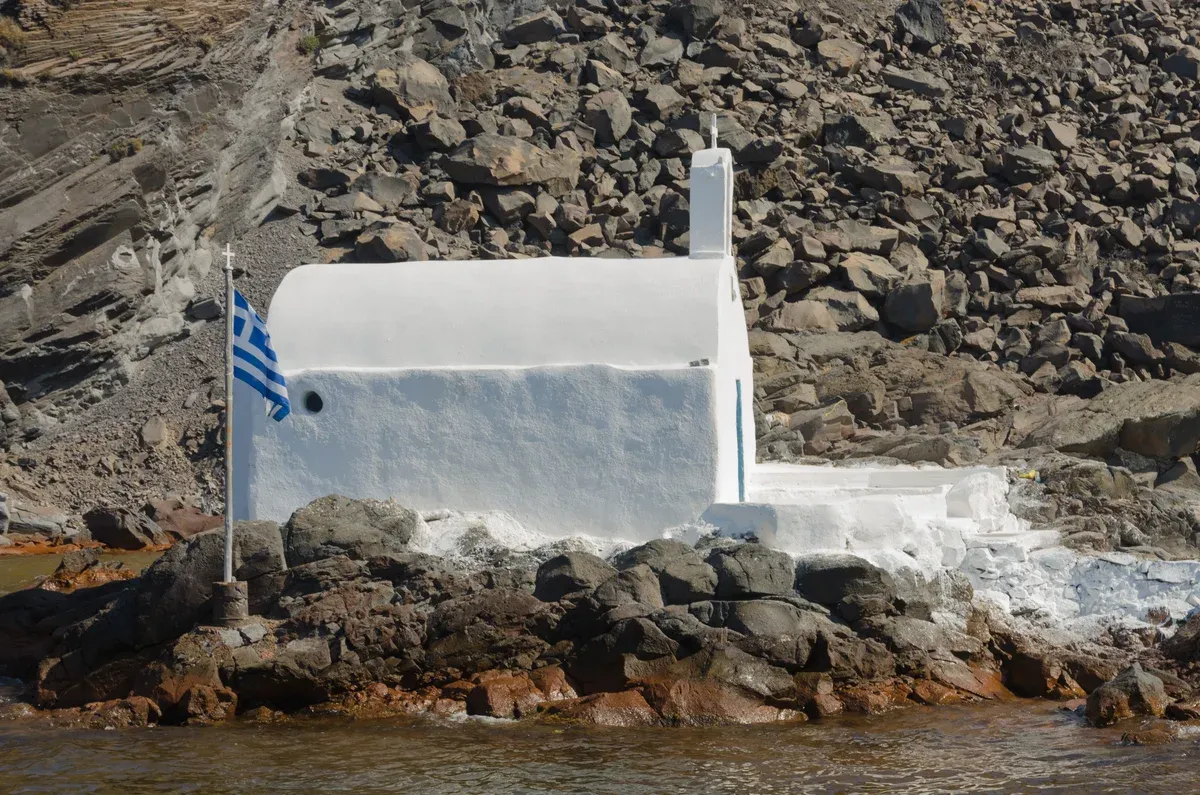
The small chapel on Palea Kameni in the caldera. Photo: Norbert Nagel, CC BY-SA 3.0, via Wikimedia Commons
The Volcano From a Catamaran
A catamaran shows you the Santorini volcano the easy way: from the water, with a meal and a swim stop thrown in.
What The Route Looks Like
Catamarans from Vlychada Marina and Ammoudi Bay list Red Beach and White Beach as stops, and some also list Nea Kameni, Palea Kameni or the hot springs. The listings describe no landing on the volcano, no crater walk and no 5 euro fee. That is the difference between a volcano tour on a dedicated boat and a day on a catamaran: you trade the climb for about 5 hours of sailing, food and swimming.
| Cruise | Price | Volcano stop |
|---|---|---|
| Renieris Classic Catamaran | $98 per person | Lists Nea Kameni as a stop |
| Sunset Oia Luxury Open Bar | $124 per person | Lists Nea Kameni and Palia Kameni as stops |
| Santorini Day Tours Small Cruise | $171.79 per person | Swim at the Palea Kameni warm springs |
Three Cruises That List The Kameni Islands
The Renieris Classic Catamaran is a 5-hour cruise from Vlychada Marina at $98 per person, with Nea Kameni on its list of stops and an onboard BBQ with unlimited dry white wine. The Sunset Oia Luxury Open Bar caps the group at 20 guests, costs $124 per person and lists Nea Kameni, Palia Kameni and the hot springs among its stops. The Santorini Day Tours Small Cruise leaves Ammoudi Bay for up to 20 guests at $171.79 per person and stops for a swim at the Palea Kameni warm springs.
You can see all of the Santorini catamaran cruises side by side on the Santorini catamaran cruise.
One Paragraph On The Springs
The hot springs sit in a small cove off Palea Kameni, not on the volcano itself. The water is warmer than the surrounding sea and tinted orange and brown by sulfur, iron and manganese, and the swim from the anchored boat is a short open-water distance of roughly 50 meters. Sulfur can permanently stain white swimsuits and silver jewelry.
The Santorini hot springs guide covers the swim in detail.
One Paragraph On The Caldera
The islands you sail around sit inside the Santorini caldera, a flooded crater about 12 by 7 km with cliffs up to 300 meters high on three sides and water up to 385 meters deep. The landscape and how it formed are covered on the Santorini caldera page.
Tips For Visiting The Volcano
Do
- Do bring euro notes for the €5 per person landing fee because rangers collect it in cash at the trailhead and card readers on the island are unreliable.
- Do wear closed-toe shoes with grip because the lava rock is razor sharp and the path is gravel.
- Do carry at least 500 ml of water per person and a hat with SPF 50 or higher sunscreen because Nea Kameni has no shade and no shops, and July and August are the hardest months.
- Do check that your boat actually stops at Nea Kameni because catamaran listings describe no landing and the rim walk belongs to dedicated volcano boats.
- Do plan the walk for about an hour on the island because the climb to the rim takes 20 to 30 minutes and most groups spend about 10 minutes at the top.
Don't
- Don't assume the landing fee is in your ticket because it is almost never included in the boat ticket and is paid separately at the site.
- Don't book a catamaran expecting to climb the crater because the catamaran listings describe no landing on Nea Kameni.
- Don't attempt the rim in flip-flops because the lava rock is razor sharp and the path is gravel.
- Don't worry that a boat trip means the volcano is about to blow, because Nea Kameni is a protected site monitored by ISMOSAV with no signs of an imminent eruption, even after thousands of quakes with a state of emergency declared on the island and an early 2026 swarm that passed with no evacuations.
Frequently Asked Questions
Where is the Santorini volcano located?
The active volcanic islands of Nea Kameni and Palea Kameni sit in the center of the flooded caldera between Santorini and Thirassia, reached by a boat trip of about 20 to 30 minutes from the Old Port or Athinios. The Santorini caldera guide covers the setting.
Can you walk on the Santorini volcano?
Yes, a gravel path leads to the crater rim on Nea Kameni, a 20 to 30 minute climb, and you can walk a full circuit of the rim. You need a dedicated volcano boat, because a catamaran cruise in Santorini only sails past.
How much does the Santorini volcano tour cost?
The landing fee on Nea Kameni is €5 per person in cash at the site, on top of your boat ticket, and short volcano cruises run 2.5 to 3 hours. Catamaran alternatives start at $67 per person on the tour comparison page.
Is the Santorini volcano active?
The volcano is dormant rather than extinct: its last eruption was a small lava dome on Nea Kameni in 1950, gas emissions of CO2, SO2 and H2S continue, and ISMOSAV monitors the site with readings showing it remains dormant.
Do catamaran cruises land on Nea Kameni?
No catamaran listing describes a landing on Nea Kameni, so the crater walk and its 5 euro fee do not apply. The Sunset Oia Luxury Open Bar lists Nea Kameni among its stops at $124 per person.
When did the Santorini volcano last erupt?
The last eruption in the caldera was in 1950, a small lava dome extrusion on Nea Kameni, one of nine subaerial eruptions on the Kameni islands since 197 BC.